The
Indus Valley Civilization (
IVC) was a
Bronze Age civilization (3300–1300 BCE; mature period 2600–1900 BCE) which was centred mostly in the western part
of the
Indian Subcontinent and which flourished around the
Indus River basin.
Primarily centered along the Indus and the
Punjab region, the civilization extended into the
Ghaggar-Hakra River valley
and the
Ganges-Yamuna Doab,
encompassing most of what is now
Pakistan, as well as extending into the westernmost states of modern-day
India, southeastern
Afghanistan, and the easternmost part of
Balochistan,
Iran.
The mature phase of this civilization is known as the
Harappan Civilization, as the first of its cities to be unearthed was the one at
Harappa, excavated in the 1920s in what was at the time the
Punjab province of
British India (now in
Pakistan).
Excavation of IVC sites have been ongoing since 1920, with important breakthroughs occurring as recently as 1999.
Mohenjo-Daro, a
UNESCO World Heritage Site, is another well-known IVC archeological site.
The
Harappan language is not directly attested and its affiliation is unknown, though
Proto-Dravidian,
Elamo-Dravidian, or (Para-)Munda relations have been posited by scholars such as
Iravatham Mahadevan,
Asko Parpola,
F.B.J. Kuiper, and
Michael Witzel.
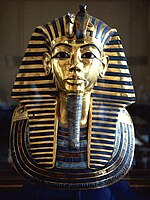 Ancient Egypt was an ancient civilization of eastern North Africa, concentrated along the lower reaches of the Nile River in what is now the modern country of Egypt. The civilization coalesced around 3150 BC with the political unification of Upper and Lower Egypt under the first pharaoh, and it developed over the next two millennia. Ancient Egypt reached its pinnacle during the New Kingdom, after which it entered a period of slow decline. Egypt was conquered by a succession of foreign powers in this late period, and the rule of the pharaohs officially ended in 31 BC when the early Roman Empire conquered Egypt and made it a province.